
PLACOBDELLA COSTATA
Order RHYNCHOBELLIDA
Family GLOSSIPHONIIDAE
Placobdella costata (Fr. Müller, 1846)
= Haementaria costata
Identification
Key, plus text and illustrations, is provided by Elliott and Dobson (2015).
Distribution
First recorded in Britain by Elliott et al. (1979). Highly localised distribution with records from Lancashire, Somerset, Devon, Norfolk, Essex and Kent. Two historical records from central Scotland but no modern records. Recent records from 11 hectads.
Habitat and ecology
In Europe, this species has been found in almost all types of fresh water, including ponds, ditches, lakes, springs, streams and rivers. It usually occurs where aquatic macrophytes are present. It is a blood-feeding leech reported to feed upon amphibians, water birds and mammals, including occasionally humans. Feeding can take up to two hours, and the process can increase the leech’s weight by a factor of seven. Satiated leeches and those carrying eggs tend to remain amongst stones on the bottom, whilst hungry leeches and those carrying young are usually attached to the leaves of aquatic plants and are thus in a position to attack a host. This would suggest that leeches carrying young could be dispersed by waterfowl. Breeding takes place in summer. The life cycle in the field can take one, two or three years, and specimens have survived for up to two and a half years in the laboratory.
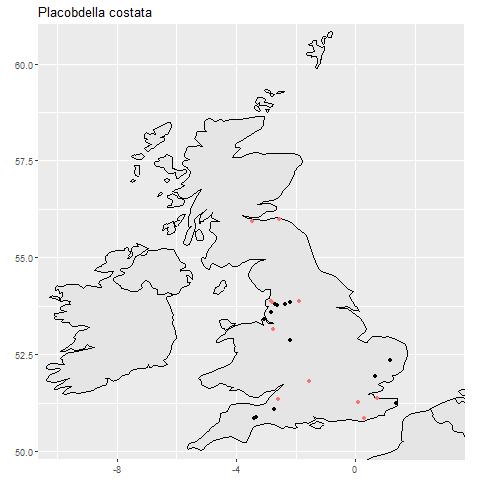
Red dots are historical (> 10 years old), black dots current (<= 10 years old).
 Freshwater Leech Recording Scheme